The Commercial Benefits of Industrial Hydraulic Wood Presses: Optimising Factory Floor Efficiency and Output Quality
In high-volume manufacturing environments, capital expenditure on production machinery must be justified by clear operational returns. Integrating a modern industrial hydraulic wood press into your facility directly impacts your bottom line by boosting throughput, enhancing structural consistency, reducing material waste, and lowering floor-staff labour costs.
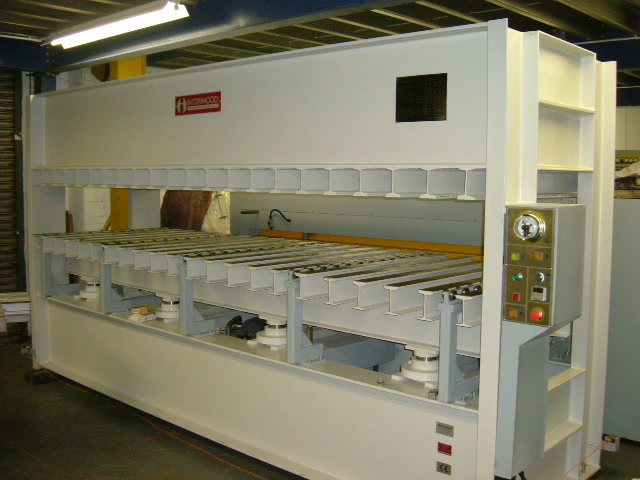
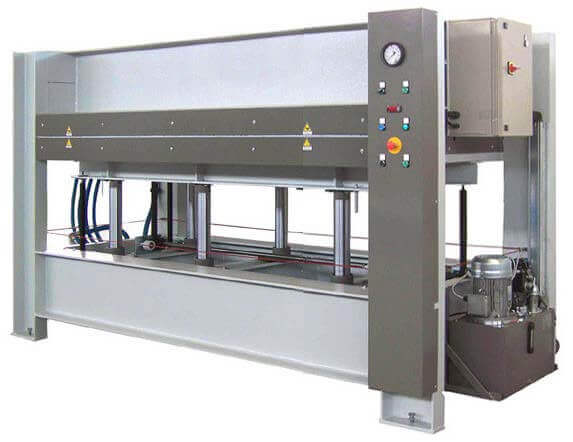
A heavy-duty hydraulic press utilizes engineered force to execute precise compression, laminating, and shaping cycles under extreme pressure. Designed with a high-capacity main frame and rigid hydraulic cylinders driven by a central power pack, modern systems offer the rigidity required for decades of uninterrupted operation. These industrial assets can be configured with automated conveyor integrations and heated or ambient platens to match specific facility workflows.
Industrial Press Configurations and Operational Workflows
1. Through-Feed Automated Press Lines
For operations focused on reducing cycle times and minimising labour overhead, through-feed lines automate panel insertion, compression, and extraction.
- Core Engineering Applications: Ideal for high-speed bonding of architectural veneers, engineered laminates, advanced composites, and PVC substrates onto core structural panels (MDF, plywood, or blockboard).
- Turnkey Line Automation: A baseline installation integrates a heavy-duty feed belt, an automatic press unit, and a high-capacity discharge deck.
- Scalable Integrations: Lines can be completely expanded with automated glue spreaders, panel polishers, automatic feeders, panel turners, and robotic stackers to achieve fully automated production requiring zero manual operator intervention.
2. Automated Processing Systems
These advanced processing lines link multiple production phases into a singular, unified workspace. Systems track parts seamlessly from raw material cleaning and brushing stages through automated adhesive application, precision pressing, and inline dimension cutting.
3. Kinematic Profiles: Down-Stroke vs. Up-Stroke Machines
Selecting the appropriate mechanical stroke action depends heavily on your specific workflow footprint:
- Down-Acting Hydraulic Presses: Featuring an upper moving beam that descends to apply tonnage against a fixed lower bolster, these classic C- or O- frame profiles offer stable rigidity. They are the preferred machine type when staged bending over multiple inline stations is required, eliminating the risk of ram tilt. Because the upper beam uses active hydraulic power to rise and fall, facilities often block these beams overnight to relieve system pressure and ensure workshop safety.
- Up-Acting Hydraulic Presses: These systems apply hydraulic force from the centre of a moving lower beam, pressing upward into a stationary upper structure. Up-acting configurations use gravity for the return stroke, ensuring that any loss of facility power automatically leaves the die in an open safe position. This configuration provides operators with immediate mechanical feedback during active processing cycles.
Material-Specific Hydraulic Press Categories
Industrial Platen Systems (Hot and Cold Presses)
Operating plane-to-plane, high-capacity platen presses form the backbone of modern composite and wood panel production.
- Heated Platens (Hot Presses): Utilize internal chambers circulating thermal oil, steam, or electric elements to rapidly cure industrial resins and expedite high-volume cycles.
- Ambient Platens (Cold Presses): Generate uniform compression under room temperatures, offering an energy-efficient solution where curing times can be managed inline.
Multi-Daylight Systems
Designed with multiple stacked platens, multi-daylight presses allow manufacturing teams to press a large series of panels simultaneously, maximising batch output for doors, wall systems, and layered composite boards.
High-Precision Veneering Stations
Engineered to deliver flawlessly uniform surface pressure while bonding decorative skins to composite substrates, veneer presses are typically paired with integrated brushing machines, glue spreaders, and industrial guillotines to form complete veneer finishing cells.
Advanced Composite Compression
Engineered for industries demanding lightweight, ultra-strength components, specialised composite presses process technical materials for highly regulated sectors:
- Automotive: Structural carbon-fibre body panels and protective battery enclosures for electric vehicles.
- Aerospace: High-specification interior seating housings and ultra-light architectural panels.
- Defence: Impact-resistant, bulletproof floor pans and defensive plating for tactical vehicles.
- Refrigeration: High-density, insulated thermal panels for commercial cold storage structures.
Structural Industrial Laminating
Laminating presses handle the heavy-duty bonding of layered construction elements. These systems cure structural timbers and composite building materials, preparing them to withstand immense engineering workloads without structural failure or delamination.
Heavy Rubber and Elastomer Systems
Configured to handle high-density rubber processing, these specialized presses form heavy agricultural components, aircraft tires, and vulcanized PVC or rubber conveyor belts utilized in industrial recycling hubs, sorting facilities, and heavy transit networks.
CNC Precision Punch Presses
Utilizing identical high-pressure hydraulic frameworks, punch presses are integrated with CNC tooling matrices to execute precision perforations and component shaping via automated die sets, maintaining strict tolerances across large production runs.
Custom OEM Engineering Solutions by Allwood
With decades of engineering experience developing high-tonnage machinery for the industrial sector, Allwood offers a comprehensive catalog of processing machinery designed to withstand rigorous commercial environments.
As the exclusive provider of modern Interwood Presses, we supply factories worldwide with factory-floor solutions tailored to complex throughput targets. If your facility requires custom footings, bespoke automation integration, or non-standard platen dimensions, our design team can engineer a machine precisely to your technical requirements.
Contact Our Technical Engineering Team for an Asset Consultation