Industrial Brushing Machines: Mechanical Principles and ROI in Panel Processing
In commercial joinery, architectural panel processing, and timber manufacturing, surface preparation directly dictates the quality of downstream bonding, lamination, and finishing. While manual denibbing and surface cleaning remain common bottlenecks in smaller operations, integrating high-throughput industrial brushing machines into automated production lines offers a measurable reduction in unit labour costs and material wastage.
Whether processing structural components for building partitions or pre-cleaning substrates for high-pressure lamination, industrial brushing equipment provides continuous, mechanical surface manipulation at speeds unachievable through manual labour.
Engineering Principles: Mechanical Action and Filament Dynamics
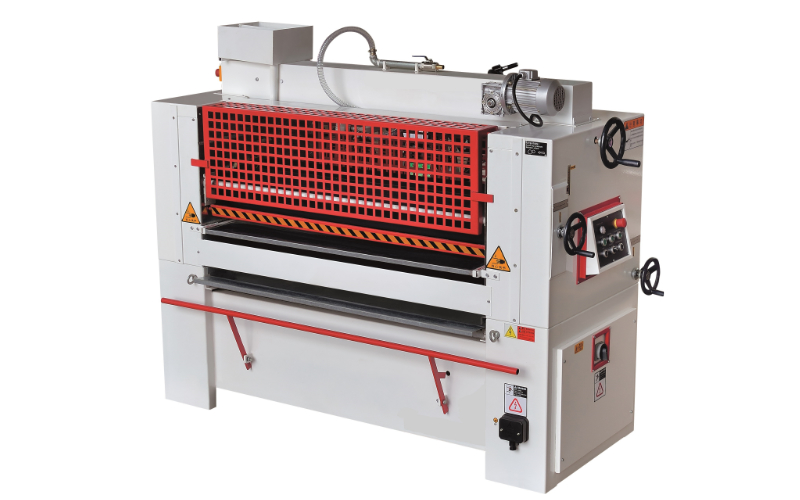
Industrial brushing machines utilise heavy-duty, motor-driven rotating roller heads fitted with specialised abrasive, wire, or synthetic filaments. By precisely controlling surface contact pressure, brush head rotation, and line feed speeds, these machines achieve rapid surface transformation across hardwoods, softwoods, MDF, and composite boards.
- Filament Selection & Application: High-grade abrasive nylon filaments (impregnated with silicon carbide or aluminium oxide) are specified for uniform intermediate sanding, denibbing, and surface calibration. Stiffened steel wire matrices are deployed for aggressive grain distressing and deep texturing, while natural or soft synthetic fibres provide static removal and fine dust suppression prior to adhesive application.
- Kinematics & Oscillation: Advanced industrial models incorporate transverse oscillation alongside primary head rotation. This multi-axis movement eliminates directional machining marks, ensuring homogenous surface profiling across wide-format panels.
- Process Customisation: Variable frequency drives (VFDs) enable factory operators to fine-tune spindle RPM, feed conveyor velocity, and head elevation to accommodate varying substrate densities and delicate surface veneers.
Calculating the B2B Value Proposition: Amortisation & Labour Offset
From a capital expenditure (CapEx) perspective, an industrial brushing machine serves as a direct labour-replacement asset. When evaluating the total cost of employment (including base wages, National Insurance contributions, holiday entitlements, and workplace pension provisions) a standalone brushing machine typically achieves full capital payback in under 12 months.
Beyond immediate payroll savings, automated brushing yields several operational efficiencies:
- Defect Reduction: Eliminating manual sanding variance prevents low-spot skips and surface gouging, safeguarding high-value substrates.
- Adhesive Bond Integrity: Removing microscopic wood dust and raised fibres ensures optimal wet-out and mechanical keying when panels pass into automated glue spreaders or presses.
- Continuous Production Speed: Automated feed rates integrate seamlessly into high-speed through-feed lines, preventing upstream staging bottlenecks.
Integrating Brushing Equipment into Automated Pressing Lines
To achieve maximum efficiency, industrial brushing machines are rarely deployed in isolation. They form the foundational cleaning step in multi-stage surface processing lines alongside other key capital assets:
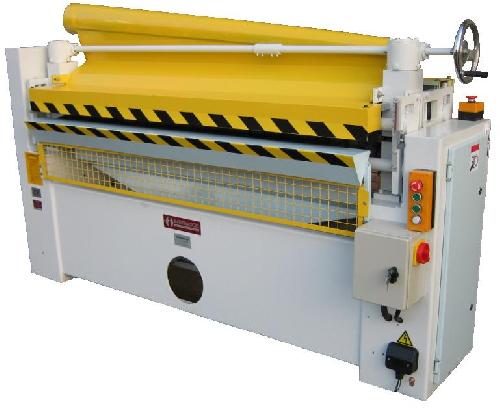
- Automated Glue Spreaders: Passing freshly brushed, dust-free substrates directly into a 4-roller glue spreader ensures accurate adhesive coat-weight distribution without contamination or surface telegraphing.
- Industrial Pressing Systems: Whether utilising ambient-cure cold presses for multi-panel batch stacking or rapid heated platen hot presses for high-volume lamination, pre-cleaned panels guarantee superior glue-line integrity and eliminate costly delamination claims.
- Veneer Guillotines & Saws: For high-specification architectural veneers, pairing precise guillotine edge-cutting with downstream panel sizing via sliding table saws completes an automated, high-yield processing cell.
Factory-Direct Engineering & Interwood Solutions
As the exclusive provider of modern Interwood Presses and processing machinery, Allwood supplies industrial facilities directly with heavy-duty equipment built for continuous operational uptime. Our engineering team consults directly with production managers to specify, custom-build, and integrate bespoke machinery cells tailored to exact volume targets.
Looking to Automate Your Surface Preparation and Panel Processing Line?
Contact the Allwood technical consultancy team directly on 01621 859477 to discuss machinery specifications, line integration, and capital investment proposals.